

Brake Repair & Service in Austin & Round Rock, TX
A squeal at the first stop of the morning, a shudder on the off-ramp, a pedal that sinks a little deeper than it used to — your brakes are telling you something, and guessing isn't a strategy. Total Auto Works does brake repair the measured way: we put your pad thickness and rotor wear in front of you, in millimeters, then hand you a written estimate before any work begins. If you only need pads, you only buy pads — nobody here earns commission for finding 'problems.' We service brakes on every make, including European, at our North Austin and Round Rock shops, and we come from the team behind Luxury Auto Works. When your car needs to stop like it should, this is where Austin drivers start.
What's included
- Pad thickness and rotor wear measured — and shown to you — before we quote anything
- Front and rear pads, rotors, calipers, brake hoses, and ABS repair
- OEM-grade pads and rotors standard — no bargain-bin friction material
- Brake fluid tested for moisture before we'll ever recommend a flush
- Written estimate before any work begins — every time
- 12-month / 12,000-mile warranty on parts and labor
We show you the worn parts
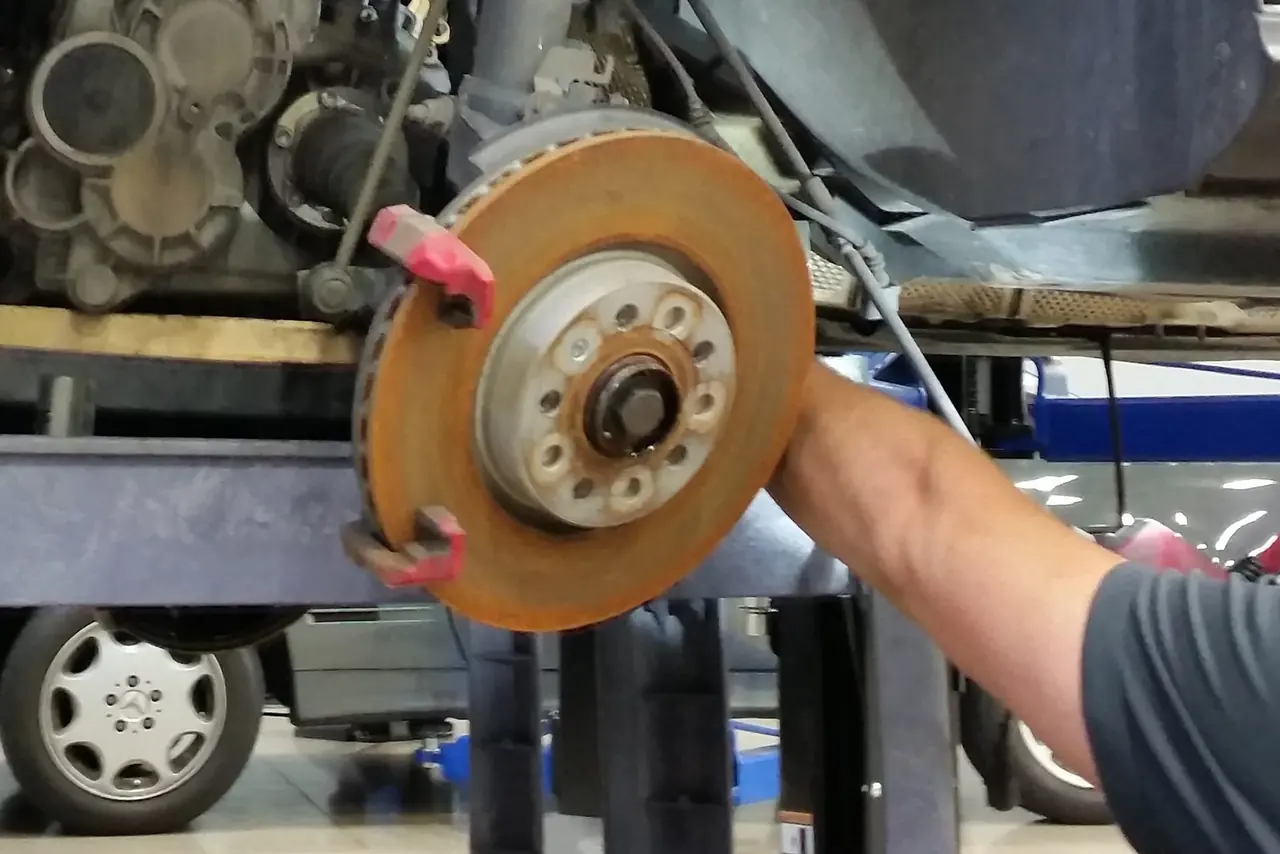
Most brake upsells survive on one thing: you can't see your own pads. We take that excuse off the table. Every brake inspection here is measurement-based — pad thickness in millimeters, rotor thickness checked against the minimum spec stamped on the rotor itself, fluid moisture read from a meter instead of a hunch. Then we show you. Worn parts come out to the waiting room, or you get photos with the measurements written on them, so you approve what you can actually see. Next comes a written estimate before any work begins — always. Approve it, and that's the number. Our service advisors aren't paid commission on what they sell, so nobody in this building gets richer by 'finding' brake problems. If your pads have life left, we'll tell you how much and when to check again. Measure, show, quote, fix — in that order, every time.
Pads, rotors, and the truth about 'lifetime' brakes
'Lifetime brake pads' is one of the oldest tricks in this industry: the pads are free forever, but the labor, rotors, and hardware — where the real money lives — are not. Bargain friction material is soft on price and hard on everything else. It fades when it gets hot, coats your wheels in dust, squeals early, and chews through rotors, so you end up back in a bay paying for the expensive half of the job twice as often. We don't play that game. Our standard is OEM-grade pads and rotors — friction material matched to your vehicle's engineering spec for stopping distance, noise, and heat tolerance, not to a price point. When there's a legitimate choice between quality tiers, we lay out the trade-offs in plain English and let you decide. Either way, the work is backed by our 12-month / 12,000-mile warranty on parts and labor — because parts we trust are easy to stand behind.
Austin driving is hard on brakes
Brakes turn motion into heat, and Austin manufactures both. A crawling I-35 commute or the daily MoPac merge-and-brake cycle means hundreds of stops a week, and every one is a heat cycle your pads and rotors have to absorb — in a city that spends half the summer above 100 degrees, that heat has nowhere to go. Add the hills west of town, a boat headed to Lake Travis, or a loaded work truck, and brake systems here wear faster than the owner's-manual averages written for milder places. The answer isn't replacing parts early — it's measuring often. Have your pads and rotors measured at every oil change, and come in any time you notice squealing, pulsing, a soft pedal, or longer stops. Both shops — North Austin on N. Lamar and Round Rock on Louis Henna — are open Monday through Friday, 8 to 6, and a free shuttle within 10 miles means a brake inspection doesn't cost you a workday.
Frequently asked questions
How much does a brake job cost in Austin?
Four things drive the number: your vehicle (a heavy truck or SUV takes bigger, costlier parts than a compact), whether you need pads only or pads plus rotors, the friction material your vehicle calls for, and whether hardware like calipers or hoses is worn. That's why we measure first and hand you a written quote before any work begins — the number you approve is the number you pay.
Do I need new rotors, or just pads?
If your rotors measure above the manufacturer's minimum thickness and are smooth and true, pads alone are the right call — and we'll tell you so. Rotors need attention when they're below minimum spec, scored from metal-on-metal contact, or causing pedal pulsation. We measure every rotor and show you the numbers, so 'you need rotors too' is a measurement here, not a sales pitch.
How long do brake pads last in Austin traffic?
Stop-and-go on I-35 or MoPac is the hardest duty brakes see — constant heat cycles wear pads far faster than highway cruising, and Austin summers pile on. City-heavy commuters often see pads done around 25,000–40,000 miles; mostly-highway drivers can roughly double that. Towing and Hill Country grades shorten it further. Replace on measurement, not mileage — have your pads checked at every oil change.
What does it mean if my brakes are squeaking vs. grinding?
Squeaking is usually the built-in wear indicator telling you the pads are getting low — annoying, but you have time to plan the job. Grinding is metal on metal: the pad is gone and its backing plate is eating your rotor, turning a pads-only repair into pads plus rotors. Squeak means schedule an inspection soon; grind means stop driving on it.
Should I get ceramic or semi-metallic brake pads?
Ceramic pads run quieter, dust less, and are the right fit for most daily drivers in Austin traffic. Semi-metallic pads bite harder and shed heat better — the better call for towing, heavy trucks, and hard Hill Country driving. We match the pad to how you actually drive, and if the less expensive option is genuinely the better one for your vehicle, we'll say so.
Do I really need a brake fluid flush, or is that an upsell?
Both answers are true, depending on the shop. Brake fluid absorbs moisture over time, which lowers its boiling point and corrodes ABS components — so flushes are a legitimate service, typically every two to three years or per your owner's manual. They're also one of the most over-sold items in the business. We test your fluid's moisture content first; if it passes, we tell you to skip the flush. If we recommend one, it's because the meter said so — not the sales board.
How do I know if my rotors are warped?
A pulsing brake pedal or a steering-wheel shimmy that appears only while braking — especially from highway speed — is the classic sign. Long downhill braking can bring on a shudder too. The true cause is usually uneven pad deposits or rotor thickness variation rather than a literal warp, but the fix is the same: we measure runout and thickness, then machine or replace only what the numbers justify.
Brake Service by location
Other services we offer in Austin
Brake Service by Make
We handle brake service on every make we service — domestic, import and European. Pick yours for model-specific detail.
Areas We Serve
Both shops draw from across the north Austin metro. Find the drive from your side of town.
Read more about this
Plain-English explanations of the symptoms and costs people ask us about most.
Ready to book brake service?
Two Austin-area locations. Same-day service often available.